

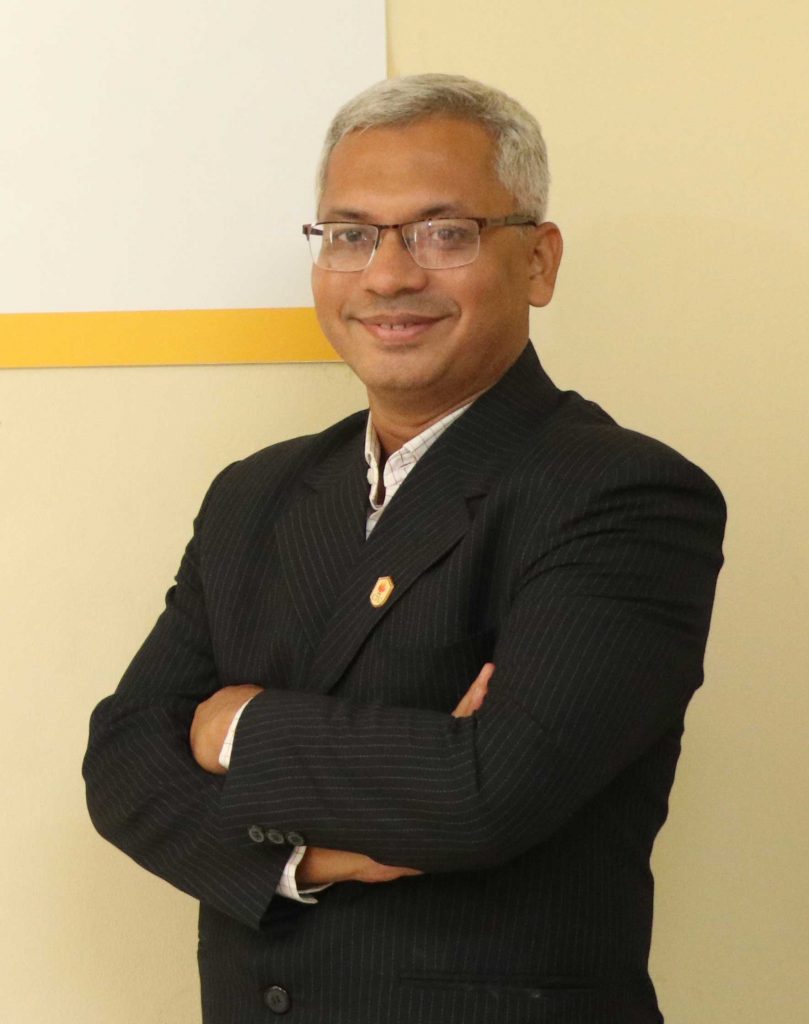
Professor of Management | Academic Leader | Researcher
PhD, MPhil (Management in Government) | MBA (Marketing), IBA, University of Dhaka | BBA (Management), University of Chittagong
E-mail: moslehuddin.khaled@ciu.edu.bd | moslehuddin.c.khaled@gmail.com
Dr. Moslehuddin Chowdhury Khaled is a Professor of Management at Chittagong Independent University (CIU). In nearly twenty years of career in academia, he has served in academic leadership and university administration for more than a decade. He has held key responsibilities as Head of the Department of General Management and Human Resource Management and has led university centers and academic initiatives, including the Center for
Entrepreneurship, Innovation, and Sustainable Development (CEISD) and the Center of Excellence in Teaching and Learning (CETL). His work spans teaching, research, institutional development, entrepreneurship, and engagement with public, private, and non-profit organizations.
His academic and research interests center on Management in Government and public management, particularly citizen-centric, bottom-up approaches to improving public services and institutional performance. He also works in the areas of higher education, social business, entrepreneurship, human resource management, organizational development, and sustainable development.
Dr. Khaled has authored and presented more than 50 journal papers and conference contributions. His research covers Management in Government and public management, the
health and education sectors, social business, and entrepreneurship.
Pre-prints / In press
1. —— (2026). Studying Government from Management Perspective: Developing a Research Paradigm. Preprints. https://doi.org/10.20944/preprints202509.0323.v1
2. —— (2026). Paradigm Shifting Economics from Adam Smith to Mohammad Yunus: Theorizing a Global Action Model for Social Business Capitalism. Preprints. https://doi.org/10.20944/preprints202508.1126.v1
Peer-Reviewed Journal Articles
3. Khaled, M. C. (2026). Health Sector Problems in Bangladesh: Developing a Management Point of View. CU journal of Business Administration. 37(1), 95-118.
4. Khaled, M. (2025). Making Government Work: An Analysis of the Regimes and Reforms in Bangladesh, 1971-2021. CIU Journal
5. Khaled, M. (2024). Reforms and improvement initiatives in government of Bangladesh: Field observation and analysis (2010–2018). American Economic & Social Review, 13(1), 1–11.
6. Khaled, M. C (2024). Family business research in Bangladesh: A scoping review and direction for research opportunities. Global Journal of Management and Business Research, 24(2), 33–42.
7. — (2023). Contemporary status of industrial relations in readymade garments industries: Bangladesh perspective. Journal of Management, Economics, & Industrial Organization, 7(3), 60–74.
8. — (2023). What matters most for academic achievement? A cross‐cultural study on undergraduate students. International Social Science Journal, 72(247).
9. — (2023). Developing a management point of view: Case of education sector problems in a developing country. CIU Journal, 6.
10. — (2022). Integration of theory of planned behavior into actual social distancing behavior amid COVID-19. Social Sciences & Humanities Open.
11. — (2022). A multivariate analysis of the efficacy of management development programs conducted in luxury hotels of Bangladesh. CIU Journal, 5.
12. — (2022). Review of Win: How public entrepreneurship can transform the developing world. Public Administration and Policy: An Asia-Pacific Journal, 25(2).
13. —(2021). The idea of management in government: Evolution of the concepts and implications for reform. CIU Journal, 4.
14. —(2020). Citizen engagement challenges in urban disaster management programs with special reference to fire, waterlogging, and pandemics: Case of Bangladesh. Society & Sustainability, 2(1), 61–74.
15. —(2020). Lacking entrepreneurship and small business thrust in business education in developing countries: Case of Bangladesh. Business Perspective Review, 2(1), 61–76.
16. —(2020). Factors affecting job satisfaction in the tourism sector of Bangladesh. Hospitality & Tourism Review, 1(1), 48–61.
17. —(2016). Institutional capacity and governance research in Bangladesh: An eclectic review. Journal of General Education (Southern University Bangladesh), IV.
18. —(2015). Research methodology in social science: Choices of research philosophies and paradigms. Journal of General Education and Development (Southern University Bangladesh), 3(1).
19. —(2015). What is missing in government: Development theories or management basics? Cases from Bangladesh. Chittagong University Journal of Business Administration, 26.
20. — (2015). Enabling environment for green (eco) banking: Implications for banking sector of Bangladesh. Bangladesh Economic Association Annual Review.
21. —(2014). Management of Freedom University Bangladesh, Chittagong: A case of poor recruitment and organisational performance. International Journal of Teaching and Case Studies, 5(2).
22. —(2014). Strategic human resource development practices: An empirical study of steel manufacturing industries of Bangladesh. International Management Review, 10(2).
23. —(2013). Profiling the customers of Aarong and its marketing implications. Chittagong University Journal of Business Administration, 23.
24. —(2012). Real estate industry in Chittagong (Bangladesh): A survey on customer perception and expectation. Developing Country Studies, 2(2).
25. —(2012). Connecting government and private sector in education: Developing a strategic approach from the top. Chittagong University Journal of Business Administration, 21.
26. —(2012). Is the stock market overvalued? A study in the context of Bangladesh. Asian Business Review, 1(1).
27. —(2011). A synopsis of management trends and training needs for the future managers. Journal of Training and Development (Bangladesh Society of Training and Development), 19(2).
28. —(2011). Improving public management as a development imperative: Developing a practical research approach for Bangladesh. Journal of Public Administration and Policy Research, 3(2).
29. —(2010). Increasing brand communication through brand visibility in retail outlets in small cities and rural areas of Bangladesh. International Management Review, 6(2).
30. —(2010). How to increase tax revenue: Improvement of enabling environment and application of strategic management approach. The Bangladesh Accountant (Journal of ICAB), 67(38), April–June.
31. —(2009). Market prospect of locally adapted web portals: Discovering the information and communication need of Bangladeshi regular internet users. The Cost & Management (Journal of ICMAB), 37(2).
32. —(2009). Creating enabling environment for trained human resources export from Bangladesh. Journal of Training and Development (Bangladesh Society of Training and Development), 17(2).
Conference Proceedings
33. Khaled, M. C. (2022). Sustainable management: A review of the practices in the real world and implications for organizations with resource constraints. In 1st BDPF International Conference on Sustainable Circular Business, Technology and Societies (ICSCBTS). BDPF (Bangladesh Doctorate’s Platform in Finland).
34. —(2021, November 12–14). Recent reforms and improvement efforts in management in government: Field observation and analysis. In USA-based NASPAA South Asian Virtual Conference. South Asian Institute of Policy and Governance (SIPG), North South University.
35. —(2021, December 17–18). Human resource management during COVID-19 pandemic: Lessons learned from readymade garments industries of Bangladesh. In 16th South Asian Management Forum. AMDISA – Association of Management Development Institutions in South Asia, IUBAT — International University of Business Agriculture and Technology, Dhaka, Bangladesh.
36. —(2021, December 17–18). Health sector problems in Bangladesh: Developing a management point of view. In 16th South Asian Management Forum. AMDISA – Association of Management Development Institutions in South Asia, IUBAT — International University of Business Agriculture and Technology, Dhaka, Bangladesh.
37. —(2021, September 11). Education in opportunity: Rethinking the crisis in a positive way. In BLM2-ICAM4 International Joint E-Conference. Taylor’s University and University of Kelaniya, Malaysia.
38. —(2021). Changes of HRM practices around the world in the context of COVID-19: Implications for Bangladesh and developing countries. Bureau of Business Research, Faculty of Business Administration, University of Chittagong.
39. —(2021). Testing the relationship between intention and actual ‘social distancing’ behavior to reduce the spread of COVID-19: The theory of planned behavior approach. Bureau of Business Research, Faculty of Business Administration, University of Chittagong.
40. —(2017). Lacking SME perspectives and realities: The gap of business and management education in Bangladesh. In Bangladesh Academy of Business Administration (BABA) Conference. Faculty of Business Studies, University of Dhaka.
41. —(2017). Developing business-like strategic approach in government: A framework. In Association of Management Development Institutes of South Asia (AMDISA) Proceedings. MNU Business School, Maldives National University.
42. —(2017). Understanding performance and value addition of schools, programs, and departments in private universities of Bangladesh: A proposed framework. In Bangladesh Academy of Business Administration (BABA) Conference. Faculty of Business Studies, University of Dhaka.
43. —(2015). Enabling environment for green (eco) banking: Implications for banking sector of Bangladesh. In Regional Seminar of Bangladesh Economic Association. Chittagong, Bangladesh.
44. —(2015). Chittagong Social Business Center (Pvt.) Ltd: A case of sustainable management practice. In 13th South Asia Management Forum (SAMF) Conference. AMDISA and SAARC, Colombo, Sri Lanka.
45. —(2015). Supply chain management education in Bangladesh: Search for identity, contextualization, and way forward. In Supply Chain Management Conference 2015. Bangladesh Supply Chain Management Society, Chittagong, Bangladesh.
46. —(2012). Failure of development theories? Or lack of management basics: Cases from Bangladesh. In 5th International Colloquium on Business & Management (ICBM). Bangkok, Thailand.
47. —(2011). Creating enabling environment for public managers. In 11th South Asia Management Forum (SAMF) Conference. AMDISA and SAARC, Kathmandu, Nepal.
48. —(2010). Entrepreneurship, family business and innovation. Çankaya University, Ankara, Turkey.
49. —(2009). Public management: Developing a practical research approach for Bangladesh. In Public Policy and Management Conference, Center for Public Policy, Indian Institute of Management-Bangalore. IIM-Bangalore, India.
50. —(2009). Connecting education and private sector: Case of Bangladesh. In International Conference on Education, University of Brunei Darussalam, Brunei.
51. —(2009). Skilled migration from Bangladesh: Enabling environment and business opportunities. In Asian Business Research Conference, World Business Institute, Australia, Dhaka, Bangladesh.
Book Review
52. Khaled, M. C. (2022). Review of Win: How public entrepreneurship can transform the developing world, by Muhammad Fouzul Kabir Khan. Public Administration and Policy: An Asia-Pacific Journal, 25(2).
He has served as an invited speaker, training facilitator, and expert panel member for government institutions, non-profit organizations, universities, and private-sector organizations. These include the Regional Public Administration Training Center, Bangladesh Petroleum Corporation, Bangladesh Korea Technical Training Centre, Engineering Academy, Chittagong Chamber of Commerce and Industry, Bangladesh Society for Human Resource Management, Bangladesh Supply Chain Management Society, American Center Chittagong, City Bank, BRAC Bank, Mercantile Bank, and Islamic Bank Bangladesh. His training and facilitation areas include entrepreneurship, business planning, leadership, HRM, organizational behavior, team building, quality management, conflict management, business communication, office productivity, stress management, SDGs, and OBE curriculum development.
He has taught undergraduate and postgraduate courses in Management, Marketing, Human Resource Management, and Economics.
Management area courses:
Marketing area courses:
HRM area courses:
Economics courses: